


Advanced Testing Facilities: Assuring Superior Quality at Excel Bellows
At Excel Bellows, our dedication to quality extends beyond production; it includes our cutting-edge testing facilities. We implement rigorous quality control from the initial design phase through to the final assembly, embodying the principle of "quality manufactured." Our skilled engineers and committed workforce collaborate to guarantee that every product meets the highest industry benchmarks.
Our sophisticated in-house testing facilities are designed to conduct a range of specialized evaluations, including cycle life squirm assessments and yield rupture examinations, customized to fulfill specific customer needs. Each bellow undergoes a series of stringent internal inspections, adhering to comprehensive quality control protocols. A crucial element of our process is correlation testing, which contrasts design data with the final product outcomes, ensuring exceptional consistency and dependability.
To uphold precision in our products, we engage in ongoing research and development aimed at refining our manufacturing processes, ensuring the production of high-accuracy bellows. With our in-house CAD design capabilities, we generate detailed documentation that complies with the latest EJMA standards and relevant international regulations.
Every product at Excel Bellows undergoes an exhaustive series of prototype evaluations, including movement assessments, spring rate tests, squirm evaluations, burst examinations, life cycle analyses, and pressure tests across various dimensions. This thorough testing procedure guarantees that each bellow and expansion joint not only meets but surpasses stringent quality criteria at every stage of production.
1) Dye Penetration Testing at Excel Bellows:
At Excel Bellows, we offer advanced Dye Penetration Testing (Liquid Penetrant Testing, LPT) in our state-of-the-art facility. This non-destructive testing method effectively identifies surface-breaking defects in various materials, ensuring the integrity of our components.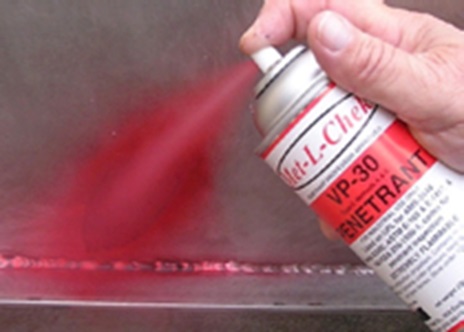
Our Process
- Cleaning: We thoroughly clean components to remove contaminants.
- Dye Application: A high-quality penetrant dye is applied to reveal defects.
- Excess Removal: We carefully remove excess dye, leaving only what's in the flaws.
- Developer Application: A developer draws the dye out for clear visibility.
- Inspection: Our skilled technicians examine the components under UV light for accurate.
2) Hydrostatic Testing at Excel Bellows:
At Excel Bellows, we offer Hydrostatic Testing, a vital non-destructive testing method to assess the integrity and pressure-holding capabilities of components like pipes, vessels, and tanks.
Our Process
- Preparation: Components are cleaned and inspected.
- Filling: The component is filled with water or another liquid.
- Pressurization: The system is pressurized to a specified level.
- Monitoring: We check for leaks and deformation during the test.
- Reporting: A detailed report of the results is provided.
3) Air Testing at Excel Bellows:
At Excel Bellows, we provide comprehensive Air Testing, an essential method for evaluating the integrity of pressure systems and components. This non-destructive testing technique is widely used to detect leaks and ensure the reliability of various applications.
Our Air Testing Process
- Preparation: Components are thoroughly inspected and cleaned before testing.
- Pressurization: The component is pressurized with air to the specified test level.
- Monitoring: We closely monitor for any signs of air leakage, often using soapy water or specialized detection equipment.
- Evaluation: Any detected leaks are evaluated to determine their severity and required actions.
4) Spring Rate Testing for at Excel Bellows:
At Excel Bellows, we specialize in Spring Rate Testing for stainless steel expansion bellows, ensuring that our products meet the necessary performance and safety standards. This testing evaluates the elasticity and load-bearing capacity of the bellows, critical for their functionality in various applications.
Our Spring Rate Testing Process
- Preparation: Each bellows unit is inspected to ensure it meets quality standards before testing.
- Setup: The bellows are mounted in a controlled environment, and measurement equipment is calibrated.
- Loading: A known weight is applied incrementally to the bellows, measuring the deflection at each load level.
- Data Collection: We record the load and corresponding deflection to calculate the spring rate, defined as the load per unit deflection.
- Analysis: The data is analyzed to ensure the bellows perform within specified parameters.
5) Life Cycle Testing at Excel Bellows:
At Excel Bellows, we conduct comprehensive Life Cycle Testing for stainless steel expansion bellows to ensure their durability, reliability, and performance over time. This testing simulates real-world conditions to evaluate how the bellows will perform throughout their operational life.
Our Life Cycle Testing Process
Preparation: Each expansion bellows is inspected for quality and conformity to specifications before testing begins.
Test Setup: The bellows are installed in a test rig that simulates the actual operational environment, including temperature fluctuations and pressure variations.
Dynamic Testing: The bellows undergo repeated cycles of movement, pressure, and thermal changes to simulate years of usage in a short time frame.
Monitoring: Throughout the testing process, we monitor for signs of fatigue, wear, or failure. Key parameters such as pressure, displacement, and temperature are recorded.
6) Radiography Testing at Excel Bellows:
At Excel Bellows, we utilize Radiography Testing (RT), a powerful non-destructive testing method that uses X-rays or gamma rays to inspect the internal structure of materials and components. This technique is essential for identifying flaws such as cracks, voids, and inclusions without compromising the integrity of the item being tested.
Our Radiography Testing Process
Preparation: The component is thoroughly cleaned and prepared for testing to ensure clear imaging results.
Setup: The item is positioned in a controlled environment, and the appropriate radiation source (X-ray or gamma ray) is selected based on the material and thickness of the component.
Exposure: The radiation is directed at the component while a radiographic film or digital detector captures the transmitted rays. This process creates an image that reveals internal features and potential defects.
Development: If using film, the exposed film is developed to produce a clear image. Digital systems provide immediate visualization.
Analysis: Our trained technicians analyze the radiographs for indications of defects or structural issues, providing a detailed report of the findings.
This Test is conduscted from NABL Approved Labouratory.
7) Helium Leak Testing at Excel Bellows:
At Excel Bellows, we offer Helium Leak Testing, a highly sensitive and reliable non-destructive testing method used to detect leaks in vacuum and pressure systems. This testing is particularly effective for applications requiring stringent leak detection, such as in aerospace, automotive, and manufacturing industries.
Our Helium Leak Testing Process
Preparation: Components are thoroughly cleaned and inspected to ensure they are free from contaminants that could interfere with testing.
Vacuum Chamber Setup: The item being tested is placed in a vacuum chamber, which is then evacuated to create a controlled environment.
Helium Application: Helium, a small and lightweight gas, is introduced to the external surface of the component.
Detection: A mass spectrometer or helium leak detector monitors the internal pressure of the component. If there are any leaks, helium will enter the system, and the detector will identify the presence of helium.
Analysis: The data collected during the test is analyzed to determine the leak rate and assess the integrity of the component.
